Labels

Showing posts with label Finance & Economy. Show all posts

Monday, March 23, 2020

Learning about Teeth

Learning about Teeth
and removing Vidheha's teeth


Sydney Dental and Dr. Shakti Sharma were very welcoming. Dr. Sharma is a wonderful dentist who takes care of Vidheha’s teeth very well. Vidheha too is a wonderful patient. After Dr. Sharma took out her central incisors she asked, “Did it hurt?”


Vidheha put on a brave face and said, “No.” She has had three teeth extracted by Dr. Sharma and never shed a single tear. Today she is to have fluoride gel to strengthen her old baby teeth and to protect her new permanent teeth.


Kindly, Sydney Dental and Dr. Sharma offered to take classes for all of us at Spiny Babbler! She had previously invited me, Anita di, Vidheha, Bhagwati ma’am and Pallav sir to their gathering a few weeks ago.


She is a very good teacher as well as dentist. She and her team welcomed us and did several demonstrations. This class was also backed up by Terry ma’am’s Skype class on mammals a week ago and how we have two sets of teeth!


1) How to brush baby teeth (20 of them!) and how to brush permanent teeth (32 of them!) and how to floss. She had a special demonstration set of teeth to show us on which there were good teeth, decayed teeth as well as root structure we could see inside of and the blood vessels as well!


2) The structure of the teeth: enamel and dentin which make up the crown area; dental pulp, cementum and the blood vessels and nerves which make up the tooth root area. She had a real tooth to show us and we looked at each other’s teeth as well as Anita didi’s teeth


3) She also taught us about baby teeth that have central incisors, lateral incisors, canines, and 2 sets of molars. She then taught us about permanent teeth that have central incisors, lateral incisors, canines, 2 sets of premolars, and 3 sets of molars.


Snigdha and Shuvam were very interactive and gave great answers to her questions and we had a few laughs as well.


The it was time for Vidheha’s demo. She got on the reclining dentist’s chair, Dr. Sharma showed us the suction pipe, she said Vidheha would have fluoride put in for 3 minutes and she could not eat or drink for 1 hour! She put cotton and a yellow container in her mouth and showed us the gel as well as the paint.


It looked scary but Vidheha said it did not hurt. The process was fascinating and we saw many things. Then it was time to talk and then look at the X-ray machine and the image on the computer of the x-ray. After that we reviewed what we had learned. We had remembered quite a bit!


It was time for group photos then and it was time to say thank you and goodbye. Thank you so much for the wonderful morning Sydney Dental and Dr. Shakti Sharma.

Sunday, February 23, 2020

The pea


The pea
Pisum sativum


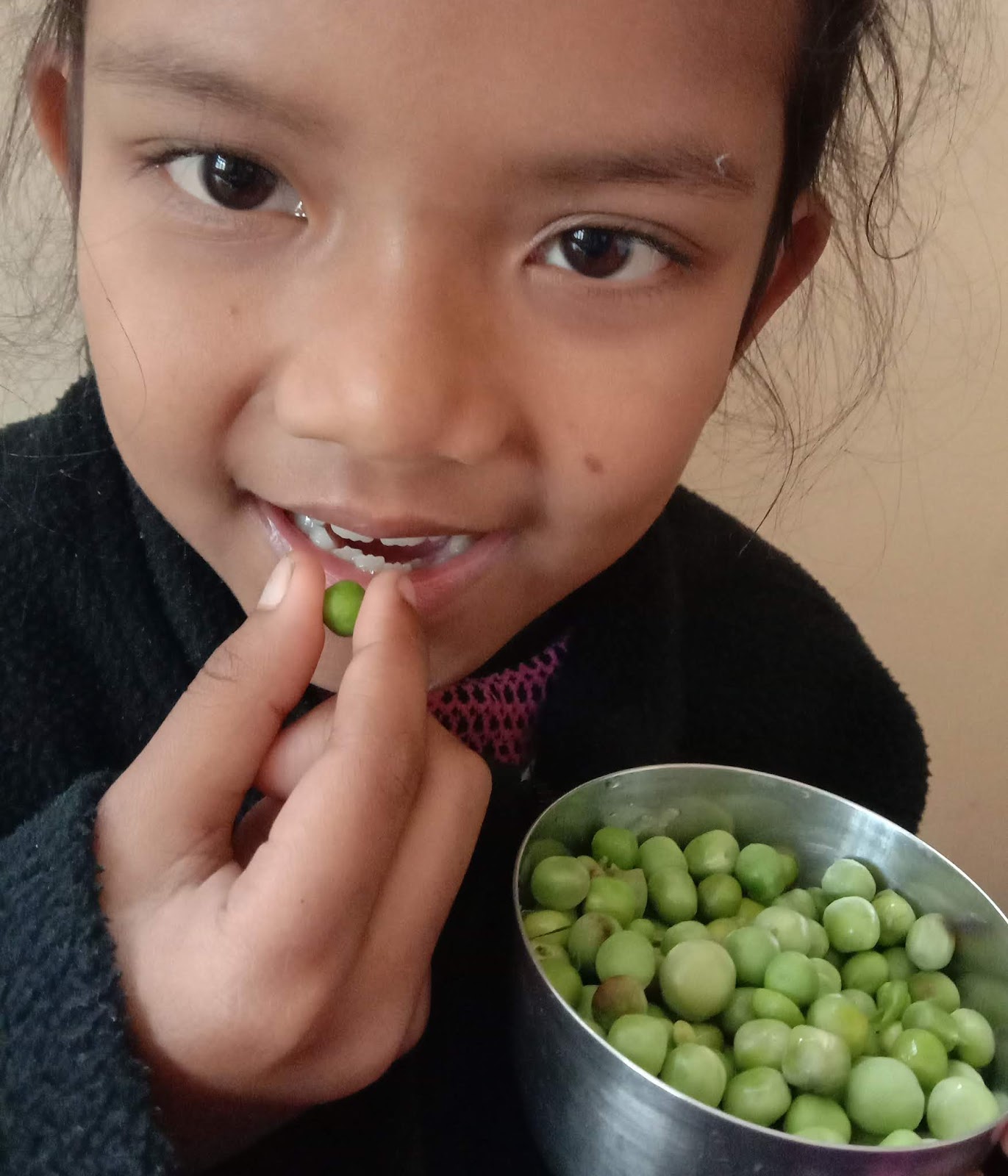
Today, 23 February 2020. We are studying the pea which is a legume and eaten as a vegetable. It is a climber.


ORIGINS: The pea is believed to have originated in the Middle East, Mediterranean, and the Egyptian Nile area.


NUTRITION: The pea gives us a lot of Vitamin C along with fibre, Vitamin A and potassium among other good nutrition.


METHODOLOGY: We were paired with a friend and received a pod to etudie (as the French put it). Shila, Krit, Aarambha, Snigdha, Vidheha, Bishes, Shuvan, Mridvika, Aadhijay and Siddhant were involved in the study. After studying the pod, we opened it and observed what was inside. We measured and described the content. Then we proceeded to document the smell and taste of the plant. 


POD: First we had to study to outside of the pod. 
- The color of the pod was green, getting darker at the back. 
- The shape was long and narrow. 
- The length was 12.1 cm and the width 2 cm.


PEAS: After studying the pod, we opened it. Inside we saw spherical seeds that were light green. There were ten peas in my pod. Two on the top and bottom was very small with the other eight being big. The smallest peas were 3 mm and 4 mm in diameter. The largest pea was almost 9 mm in diameter. On one side the peas were a little white, especially with little connecting points where they were attached to the pod. The peas were not perfectly spherical. We saw that the seed broke up into two equal parts connected together by a skin. Therefore, the pea is a dicotyledonous seed. 

SMELL: The peas smelled of green leaves but the smell was light.


TASTE: The small peas were a little sweet and bitter. The largest peas were sweet. Some did not have much taste.


Wednesday, February 12, 2020

Making cookies: baked, fried


Making cookies: baked, fried
By Shila Shrestha 


Every day, we are trying to do many different things. We went outdoors, made rice, did exercises, running, hip hop dance, experiment, artwork based on artists, played flute, madal, tambourine, piano and many other things. We have to learn so many different things.  


It was the day during Christmas so, sir told us we were going to bake some cookies. We went to Bhatbhateni to buy items for making cookies. But some kids were at school because had to stay back at school. They had classes.


At bhatbhateni we got ingredients for each person. Santa gave us 1 packet of cook. We bought sugar, cucumber, butter and other things. We shared the ingredients that we bought with one another.


Ingredients
  1. Floor
  2. Honey
  3. Coca power
  4. Milk
  5. Grinded sugar
  6. Baking soda
  7. Butter
  8. Baking powder
  9. Vanilla
  10. dark chocolate liquid 


Then we were ready to make cookies. We put floor, butter, little bit of coca power, and granted sugar and other things. Some cookies were baked and some were fried cookies. It was very yummy. The baked cookies were very hard to chew but the fried ones were not that hard to chew. The fried cookies were soft. We made cookies and we ate the cookies. We like making cookies. We had lots of fun. 


Friday, January 24, 2020

Chini Paratha


Chini Paratha
by Shila Shrestha


At 2 o’clock, we were ready to make chini paratha. These are triangular layered rotis with sugar in them. I had eaten paratha before. At school, Anita didi makes paratha better than anyone else including our teachers and cooks. And today I was going to help her make the special chini paratha which is sweet and I can imagine, very tasty.


When we cook something, first we have to wash our hands. Especially before we eat or cook after coming from outdoors. 


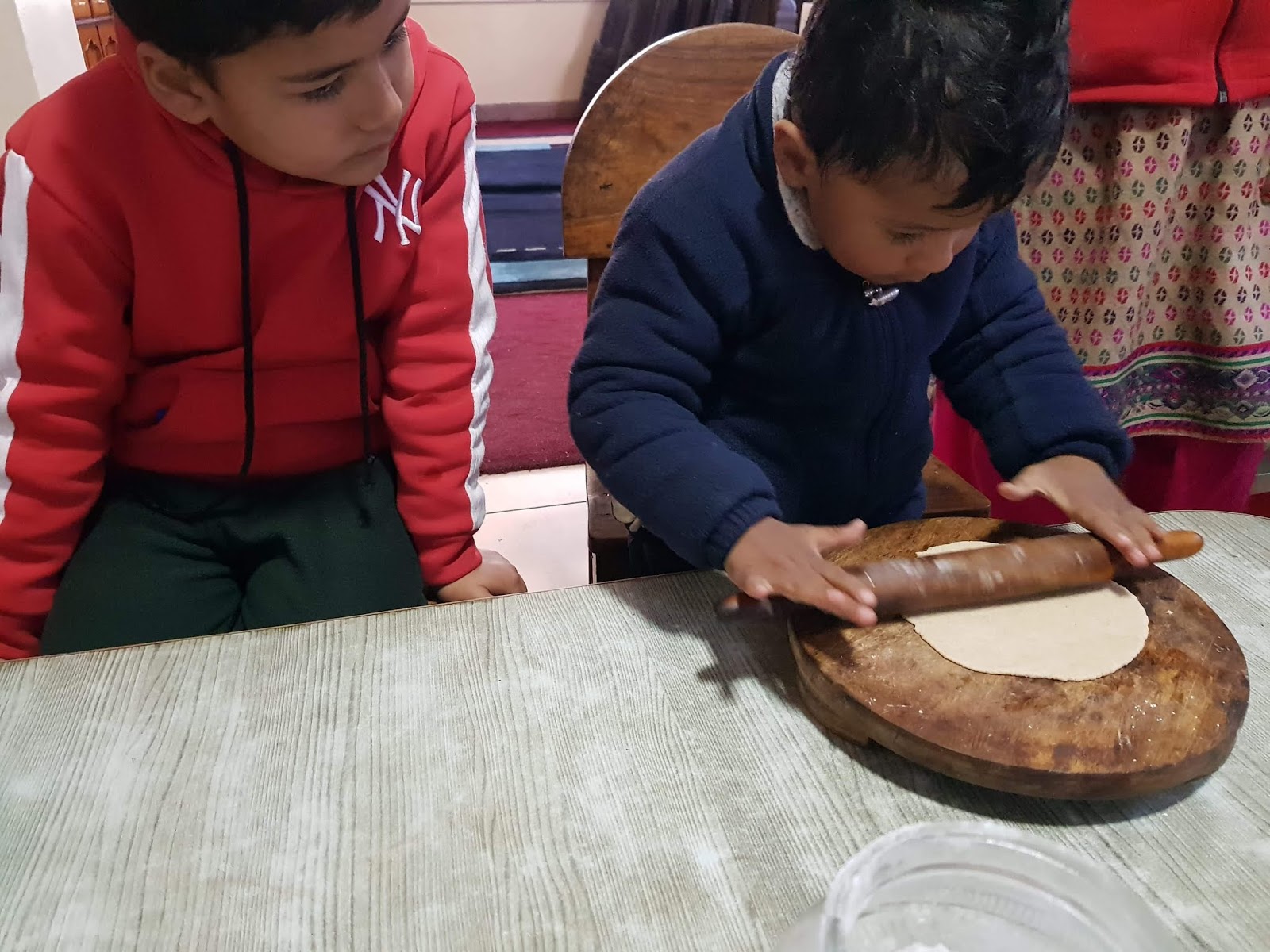
Sabita didi had already made dough. She had made a huge spherical dough. Then all of us sat around the dining table and around Anita didi. Anita didi taught everyone how to make chini paratha. She especially helped the small ones. Palistha ma’am and I took photos. 

Photography is an important part of what we do. Since we do so many exciting things at      Spiny Babbler, we need group as well as individual photos involving everyone participating. 

Sabita didi and Anita didi took out smaller lumps of dough from the big ball of dough and made round circular pieces and gave one each to all the children. Everyone flattened the round balls and got a chance to make roti. While rotis are supposed to be perfectly round, obviously, many of them were not so! We, the children, have a hard time making circles on our copybooks so we cannot make wonderfully round roti. 


Sabita didi and Anita didi helped everyone and made their rotis round. Then Anita did started folding the rotis into halves but before doing that, she spread a bit of oil and sprinkled sugar in the roti. Then she again used the rolling pin to make it bigger. Then she folding the roti again so there was a triangle. Then she added some more oil and sugar. 

Sabita didi cooked the roti. The children are allowed to use the rolling pin, spread the oil and sprinkle the sugar, but they are not allowed to go the fire and cook because the pan is too hot and can burn them. 


All the kids were very happy to make chini paratha. Now the chini paratha was ready to eat but still very hot. As soon as they cooled, the kids ate the chini paratha. They loved the chini paratha and wanted more and more. I cooked my own paratha, the shape came out quite well, I thought. It was very yummy

Wednesday, January 22, 2020

Koi carp, a scientific study


Koi carp, a scientific study
Cyprinus Carpio Linne
with dissections of Koi and common carps


Science in winter is just perfect, especially when the clouds are in the sky and threatens rain and makes things cold. Today we are going to study the Koi carp and the common carp. “I love science,” Adhijaya said when he learned that we were going to do some experiments.


The Koi carp was beautiful and orange. Pallav sir had brought it from Lagankhel. He had also brought a nice sized common carp. While we were going to study the Koi carp mostly, we were also going to dissect the common carp.


To begin with, we did a physiological study of the carps. There were two groups. Srijana ma’am took the smaller young: Kashi, Nirousha, Khayanna and Shourit. After the children had looked at the Koi carp, she had them sitting down and making artwork of studying the common carp as it was slightly bigger. Its scales were big and it was beautiful!


Sabina ma’am took over the older young: Shila, Vidheha, Anusha, Shuvam, Adhijay, Bishes. They too made artwork but Shila was busy with photography and supporting the learning. Anita didi was busy turning the research material into a readable hand out.


Once the study and the artwork was over, little 14 month old Zoya also came and we gathered around the table and started the dissection. First Pallav Sir again showed Koi has scales, skin, fins, operculum (gill cover), eyes, nostrils, barbels and lateral lines.


Pectoral, ventral, dorsal, caudal and anal fins help the fish move, he said. Pectoral and ventral fins are like hands and legs! A fin has bone-like spine, soft filament and membrane. The fin grows back if it is cut or damaged.


The barbels (which are like moustaches) help with taste as koi carp are bottom feeders that also eat food that floats. It is omnivorous. Koi carp has three rows of teeth in its neck and not in the mouth, funny! They filter plankton from water. Lateral lines are scales along the side from head to tail. They help hear the sounds. Five pairs of Saiko in the gills help the koi carp breathe.


The kois skin secretes mucus on the body which prevents parasites like worms from sticking and disease causing animals and plants. It also helps the fish swims. Koi carp is colourful because of four kinds of pigment cells. They react to light.


The scales form a circle that increase in numbers as the koi grows older. Counting the circles can help us tell the age of the koi carp. The koi does not have a stomach and the esophagus is joined with the intestines. The fatter intestine secretes the digestive fluid. They have one organ that does the work of the liver and the pancreas. The green gallbladder is connected to the liver. It has air bladder has two bubbles. The heart has pericardium, atrium, ventricle, and artery.


Anus is attached to the rectum, ureter and gonads. Gonads make sperm or ova. Koi carp lives in fresh water that is 8 to 30 degrees Centigrade. If the koi looks white, it is probably cold. Under 7 degrees, the koi carp hibernates and dies below 2 to 3 degrees.


 Koi carp eats insects, shellfish and plants. It eats everything twice, first swallowing it, then disgorges what is has swallowed when it is free and chews the food with the teeth it its neck. It lays 200,000 to 400,000 eggs that are externally fertilized and hatch average four days later. A koi carp usually lives for 70 years.


Friday, January 17, 2020

Making momo


Making momo
by Shila Shrestha


Today is Friday, 17 January 2020. It has been raining for a couple of days and nights. Its winter. So its wet and cold.

But today was a great Friday as we decided to make momos. Momos are hot and tasty. All of us sit together and work together so its fun.


As usual, the day started with music. We finished the music class. Then we played games. Then I helped to Subigya to color her artwork. We are getting ready for an art exhibition.

We were now ready to make momos. Because it was raining, we could not work outside and there was little space. We decided that we older and more experienced kids would do the work.


We asked other kids to watch Angry Birds because we were sure they would much rather eat the hot momo than sit in the cold kitchen and make hundreds of them.

After lunch we were ready, the meat was ready with minced chicken, finely cut cabbages, and soya nuggets. First we had to wash our hand because our hand could be dirty.


Then Subigya, Arya, Mirdvika, Vidheha and I sat around the dining table on our chairs. Sabita didi rolled the momo dough. I put the chicken on dough and other my friends shaped the momo.

I know how to make the momo, people say I can make them quite well. So Pallav sir asked Durga didi to put the chicken mix on the round rolled out base and said you also make momo.


Durga didi put the mix while Subigya, Vidheha, Mirdvika, Arya and I made the momo. Water had already been set to boil and the different layers of the pans oiled.

Sabita didi set the momos we had placed on the pans to cook. Arya had to go because it was very cold day his mother came to get him early. Pallav sir said you can have some momos in the car. Arya had made very nice momos and he got many on a plate to share with his mum.


We worked for about two hours, all of us and finished momo making. It was time to eat! Mirdvika ate many momos. She likes the momo. She wanted more momo. We all ate lots of momo.

However, Natasha and Raya don’t eat chicken. They are vegetarian. Pallav sir said since you don’t eat chicken, you can have egg momo. Sabita didi scrambled some eggs. I put the egg on dough and the two American sisters made momo.


After Sabita didi set the momos to steam, they ate the egg momo. I think they liked the egg momo! It looked good.

Today we made very good momo. We liked the tomato ketchup and the spicy momo sauce. Momo is always good and I like to make momo as it is so fun to do.


Sunday we will made the peanut butter said Pallav sir. Cooking is fun. I like to make things. Today was cold rainy day but it was an interesting day.