Showing posts with label The Arts. Show all posts

Wednesday, February 12, 2020

Making cookies: baked, fried


Making cookies: baked, fried
By Shila Shrestha 


Every day, we are trying to do many different things. We went outdoors, made rice, did exercises, running, hip hop dance, experiment, artwork based on artists, played flute, madal, tambourine, piano and many other things. We have to learn so many different things.  


It was the day during Christmas so, sir told us we were going to bake some cookies. We went to Bhatbhateni to buy items for making cookies. But some kids were at school because had to stay back at school. They had classes.


At bhatbhateni we got ingredients for each person. Santa gave us 1 packet of cook. We bought sugar, cucumber, butter and other things. We shared the ingredients that we bought with one another.


Ingredients
  1. Floor
  2. Honey
  3. Coca power
  4. Milk
  5. Grinded sugar
  6. Baking soda
  7. Butter
  8. Baking powder
  9. Vanilla
  10. dark chocolate liquid 


Then we were ready to make cookies. We put floor, butter, little bit of coca power, and granted sugar and other things. Some cookies were baked and some were fried cookies. It was very yummy. The baked cookies were very hard to chew but the fried ones were not that hard to chew. The fried cookies were soft. We made cookies and we ate the cookies. We like making cookies. We had lots of fun. 


Thursday, February 6, 2020

Exploring the North Side of Pashupati

Exploring the North Side of Pashupati
Commentary by Shila Shrestha with a blurb on Gaurighat by Vidheha


We are Going!

On 5 February 2020 Pallav Sir planned to take us on a visit to Pashupatinath. We have already been there many times. It would be nice. Last time when we went there, it was a little sad. Relatives were crying and because their loved ones were dead. It’s not good. So Pallav Sir said we were going to the other side of Pashupati and we would be exploring places and sites that we had read about this month in the Swasthani stories.

Getting Ready

We had to leave early, so I cooked the rice for everybody and I washed the lentil dal for Bhagwati ma’am to cook. Soon after the kids came, we ate lunch and we were ready to go. Unfortunately, the van had a flat tire so we were delayed. We went inside the van. Zoya was also going.


Songs in the Van

In the van, I was asked for the songbook and the music. Oops, I forgot so I ran along to get the pen drive and 6 copies of Song Book 1. Anil dada joined the pen drive into the sound system of the van and now we could sing songs along the way. We sang a lot of songs. 500 miles, Country Roads, Kkk Kathmandu, Buffalo Soldier, and many more.

A Little Walk, and a Carpenter

The tire had a nail so it had to be given to the garage for a while. The van stopped. We got out of the van. Pallav Sir said we would much rather walk along the Bagmati River than sit in the van doing nothing. Pallav Sir said we could climb trees. I think he was joking because we didn’t climb any trees after all. We visited a carpenter and looked at modern tools and how they helped him turn his hobby into a profession and the van came and we got on and reached the first of the temples to visit today: Gaurighat.


Vidheha Ranjan talks about Gaurighat:

Going to Gaurighat was fun. There were broken houses, there were also broken windows, there were people fighting nearby the temple. People were cleaning the river because the river was also dirty, though much better than the old days. There were lots of statues of gods near the river. There were lots of monkeys. One was eating a banana. In the old old days the Parbati, the wife of Lord Shiva stayed there when Lord Shiva went to the forests to play with the deer. When the gods stayed there the water was blue, the jungles were beautiful and the grass grew wild. The cliffs were also tall and wonderful. Now too the water is flowing but it is brown and stinks a lot. It is filled with plastic and garbage. The cliffs are tall and there is grass. But it’s not wonderful and beautiful and I wish someone would just clean the place and make the grass and water beautiful. I and my friends love going outdoors, to Gaurighat and other beautiful hikes and camps.


Moving on:

Bhagawati ma’am bought some tika and flowers. Niva didi took a class. She said we have to write about these temples. We sat on the floor got out our notebooks and pencils. We started to write about temples and what we saw there. When we were writing, people were discussing about money. We took some notes and photos. There was one big orange Hanuman and Narayan (Bishnu) sculptures.


We went to the riverside. Bhagwati ma’am bought some diya lamps. She bought five of them. Other people were also lighting diyas. We went to the riverside and the areas that had statues. She did puja there. All of us did namaste and we put on red tika. Again we took some photos with the gods. I took a photo of Bhagwati ma’am’s family also.

Kirateswor


Then we climbed up to the bridge and there was a steep hill with white walls and stone stairs. This was where Lord Shiva came as a hunter and Parbati followed him. We walked a short but steep distance up and there were many people doing puja.  This temple was called Kirateshwor mahadev. It was a nice temple. There were trees and a Shiva linga inside a beautiful courtyard. After asking for blessings, we came back down the hill and the Mrigasthali where Lord Shiva played and where there are black bucks, barking deer and spotted deer was on our right. There were blind people playing music. And since today was Ekadashi, a phase of the moon, there were a lot of worshippers everywhere. Usually when we come to these places it is a lot quieter.


Kailash Temple Area

We saw the Kailash temple are which is old. It was now broken. There were bars as the place was being repaired and we didn’t go inside. When I saw that, I was sad because we couldn’t visit that temple. The earthquake had damaged the many temples in the area and it is so sad when we hear these things.

Guheswari


We were very happy to see Bisesh and Bhagawati ma’am’s sisters and father. We put on tika for blessings. We have visited this temple many times. This temple is called Guheswori. It was very nice. Zoya wanted to come with me but she had to go with her mom. We went down and we saw a big beautiful tree. We climbed to its feet and sat down and we brought out our flutes.

Playing Our Flutes

This is the same place we played our flutes when we came here with Niki and Phoebe. We played many songs, we played: Resham Firiri, Aye kancha, Bhanjo khet ma, Changba hoi Changba, Om jaya Jagadish hare and Kalilo tamalai. When we were playing, old women came and took photos of us. One lady and one boy knew the lyrics to Aye kancha and they sang the song. Two old women wanted to take a picture with me. When they saw me, they remembered their granddaughter. Their granddaughter also played the flute and now she is in America. They wanted to give me 100 hundred rupees but I said I don't need the money. She requested that I take it many times so I took the money to share with my friends. Then we ate oranges. They was so sweet, they were nice oranges. 


Puri Tarkari

We walked to the van. We went to a local hotel and ate puri tarkari. Puri was soft but tarkari was so hot and spicy. Vidheha couldn’t eat spicy so she ate the sabudana instead.

With Bishesh’s Family

We reached Bishesh’s house and dropped him off but we all got out of the van as well. We went to Bishesh’s home and played with the bicycle. I and Bishesh know how to bicycle. Zoya ate lito as she is just 14 months old. Bhagwati ma’am mum gave us banana. Then we left and most of us were asleep in the van. Zoya slept on my lap. When she was sleeping she was so warm. I want to carry Zoya.


Some Thoughts While Coming Back

There were so many temples but most were dirty. This Gauri Ghat is a nice place and there were lots of peoples but it was really dirty and smelly. There were trees and hills and it was a very beautiful forest. The lighted diyas can also be dangerous, once child touched a buring diya while we were there. It’s so dangerous for big and small people, I thought. When we sat and played the flute there were broken glasses. I have been to these temples so many times, today was the fifth time I think, I don’t remember.

Back Home

And we reached the school. It was a nice trip because Zoya was also there and so it was a great day. I loved visiting temples and I also like to climb. I love to go camping. I want to go camping.


Friday, January 31, 2020

The Mud Wasp Or the black widow killer


Or the black widow killer
by Shila Shrestha


On the afternoon of 24th January, 2020, we found a cockroach. We collect insects when we find them so we can continue our entomological studies. As we were putting cockroach inside the plastic container where we save our samples, I saw a beautiful blue green wasp inside! Someone had found it and put it in for us to learn about!


We have studied the cockroach several times and we were going to study a different aspect of it this time but we have never ever done the mud wasp. So we were excited and asked if we could do the mud wasp study the next day. I was asked to look up the insect and do some online research beforehand.

January 25. In the morning, our teachers made ready for the wasp experiment. Our tool box was taken out along with the microscope. A teacher put the wasp on the circular glass plate. We looked the wasp which was very blue, green, black and sparkling in color. What an amazingly beautiful insect or arthropod.


While we were doing artwork Pallav sir researched more about the wasp. We wanted to know the name, where it lives, its different body parts and so much more. Sir gave us a well-researched print out to study, discuss, and make notes on.

We wrote about the details of the wasp. The wasp we had was a mud wasp, and it is also a black widow killer.


When we took wasp outside in the sun, it looked very shiny due to ray of sunlight. It sparkled like jewel. So we took photos of the mud wasp, it was so very beautiful. I had researched the taxonomy of the wasp.

We talked a lot about the mud wasp and what it does, how it lives, how it helps and why it could sting. It lives on its own, mostly! We looked at the wasp under the microscope. We looked at the body as well as the head. Little Zoya who is 14 months old also looked at the wasp through the microscope!


Classification
Scientific name: Chalybion californicum
Kingdom: Animalia (Animal)
Phylum : Arthropoda (Arthropods)
Subphylum: Hexapoda (Hexapods or with six legs)
Class: Insecta (Insect)
Order: Hymenoptera (Ants, bees, wasps and sawflies)

These are things that we wrote in our copy. It was a long class but very interesting. Then we continued on to our unfinished artwork. We drew the wasp very nicely, taking a lot of time. We were learning shading, cross hatch, circular hatch, soft blend in art class and we got to use these technique in our science class. We wanted to color the artwork! After finishing our artwork we finished to make notes.

Our experiment class went very smoothly. It was a lot of fun.

Friday, January 24, 2020

Chini Paratha


Chini Paratha
by Shila Shrestha


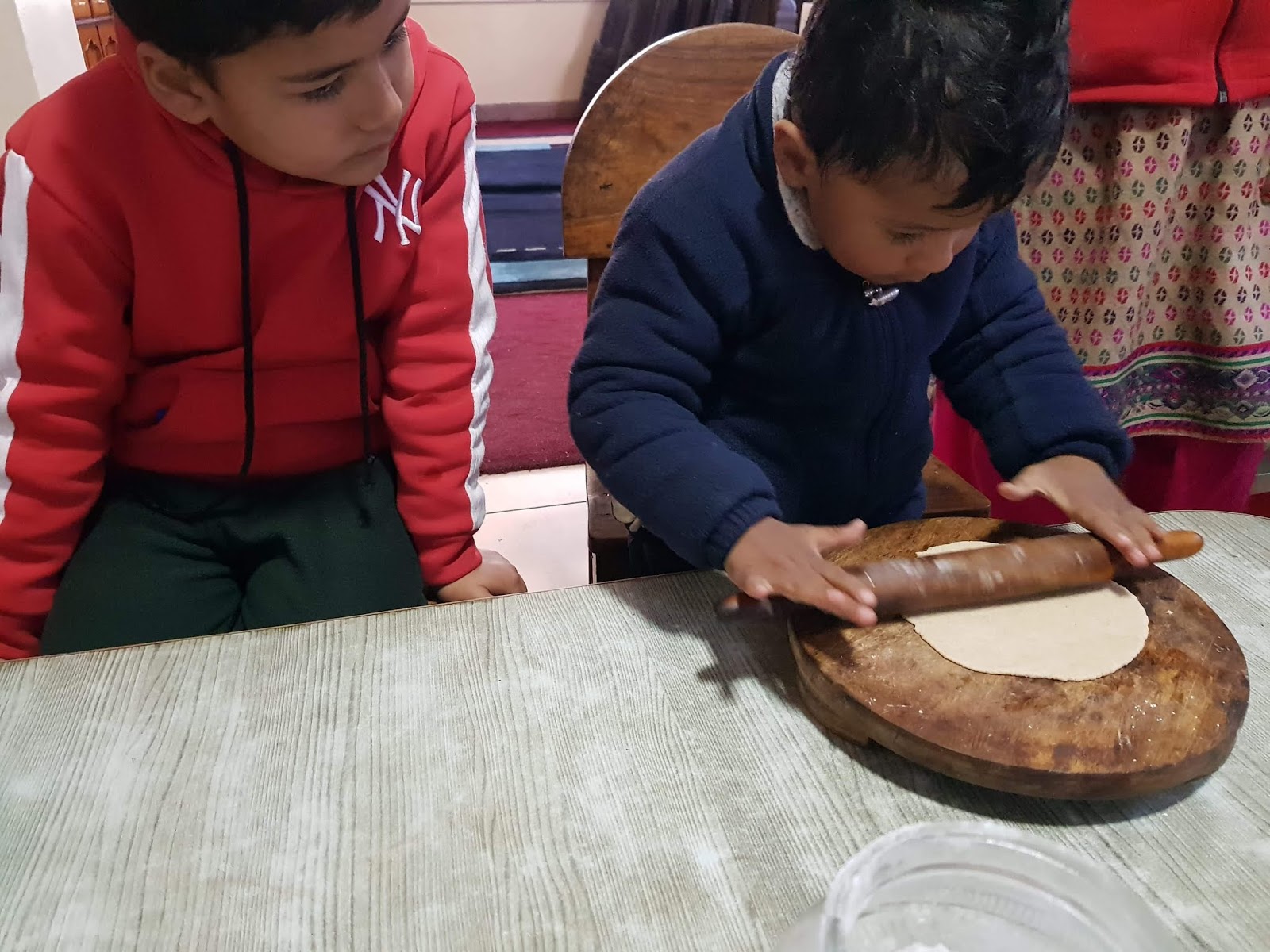
At 2 o’clock, we were ready to make chini paratha. These are triangular layered rotis with sugar in them. I had eaten paratha before. At school, Anita didi makes paratha better than anyone else including our teachers and cooks. And today I was going to help her make the special chini paratha which is sweet and I can imagine, very tasty.


When we cook something, first we have to wash our hands. Especially before we eat or cook after coming from outdoors. 


Sabita didi had already made dough. She had made a huge spherical dough. Then all of us sat around the dining table and around Anita didi. Anita didi taught everyone how to make chini paratha. She especially helped the small ones. Palistha ma’am and I took photos. 

Photography is an important part of what we do. Since we do so many exciting things at      Spiny Babbler, we need group as well as individual photos involving everyone participating. 

Sabita didi and Anita didi took out smaller lumps of dough from the big ball of dough and made round circular pieces and gave one each to all the children. Everyone flattened the round balls and got a chance to make roti. While rotis are supposed to be perfectly round, obviously, many of them were not so! We, the children, have a hard time making circles on our copybooks so we cannot make wonderfully round roti. 


Sabita didi and Anita didi helped everyone and made their rotis round. Then Anita did started folding the rotis into halves but before doing that, she spread a bit of oil and sprinkled sugar in the roti. Then she again used the rolling pin to make it bigger. Then she folding the roti again so there was a triangle. Then she added some more oil and sugar. 

Sabita didi cooked the roti. The children are allowed to use the rolling pin, spread the oil and sprinkle the sugar, but they are not allowed to go the fire and cook because the pan is too hot and can burn them. 


All the kids were very happy to make chini paratha. Now the chini paratha was ready to eat but still very hot. As soon as they cooled, the kids ate the chini paratha. They loved the chini paratha and wanted more and more. I cooked my own paratha, the shape came out quite well, I thought. It was very yummy

Wednesday, January 22, 2020

Koi carp, a scientific study


Koi carp, a scientific study
Cyprinus Carpio Linne
with dissections of Koi and common carps


Science in winter is just perfect, especially when the clouds are in the sky and threatens rain and makes things cold. Today we are going to study the Koi carp and the common carp. “I love science,” Adhijaya said when he learned that we were going to do some experiments.


The Koi carp was beautiful and orange. Pallav sir had brought it from Lagankhel. He had also brought a nice sized common carp. While we were going to study the Koi carp mostly, we were also going to dissect the common carp.


To begin with, we did a physiological study of the carps. There were two groups. Srijana ma’am took the smaller young: Kashi, Nirousha, Khayanna and Shourit. After the children had looked at the Koi carp, she had them sitting down and making artwork of studying the common carp as it was slightly bigger. Its scales were big and it was beautiful!


Sabina ma’am took over the older young: Shila, Vidheha, Anusha, Shuvam, Adhijay, Bishes. They too made artwork but Shila was busy with photography and supporting the learning. Anita didi was busy turning the research material into a readable hand out.


Once the study and the artwork was over, little 14 month old Zoya also came and we gathered around the table and started the dissection. First Pallav Sir again showed Koi has scales, skin, fins, operculum (gill cover), eyes, nostrils, barbels and lateral lines.


Pectoral, ventral, dorsal, caudal and anal fins help the fish move, he said. Pectoral and ventral fins are like hands and legs! A fin has bone-like spine, soft filament and membrane. The fin grows back if it is cut or damaged.


The barbels (which are like moustaches) help with taste as koi carp are bottom feeders that also eat food that floats. It is omnivorous. Koi carp has three rows of teeth in its neck and not in the mouth, funny! They filter plankton from water. Lateral lines are scales along the side from head to tail. They help hear the sounds. Five pairs of Saiko in the gills help the koi carp breathe.


The kois skin secretes mucus on the body which prevents parasites like worms from sticking and disease causing animals and plants. It also helps the fish swims. Koi carp is colourful because of four kinds of pigment cells. They react to light.


The scales form a circle that increase in numbers as the koi grows older. Counting the circles can help us tell the age of the koi carp. The koi does not have a stomach and the esophagus is joined with the intestines. The fatter intestine secretes the digestive fluid. They have one organ that does the work of the liver and the pancreas. The green gallbladder is connected to the liver. It has air bladder has two bubbles. The heart has pericardium, atrium, ventricle, and artery.


Anus is attached to the rectum, ureter and gonads. Gonads make sperm or ova. Koi carp lives in fresh water that is 8 to 30 degrees Centigrade. If the koi looks white, it is probably cold. Under 7 degrees, the koi carp hibernates and dies below 2 to 3 degrees.


 Koi carp eats insects, shellfish and plants. It eats everything twice, first swallowing it, then disgorges what is has swallowed when it is free and chews the food with the teeth it its neck. It lays 200,000 to 400,000 eggs that are externally fertilized and hatch average four days later. A koi carp usually lives for 70 years.


Friday, January 17, 2020

A Musical Morning


A Musical Morning


This fine morning, we worked on the flute. We were in three groups:

             The very young 3-5 year olds worked with oral singing, block play and peep peeping on their recorders.


             The older young worked to fine tune their lessons 1-6 and happy birthday song meaning that they would finish their flute foundation work!


             Then the experts including Shila and Vidheha worked to revise their 23 music        numbers and sound tuning.


             Natasha loved exploring her own sounds on the keyboard!


Spiny Babbler Evolution rang out with beautiful sounds all morning. Then we had cookies and hot chocolate and played and played.