Labels

Showing posts with label Science & Technology. Show all posts

Monday, March 23, 2020

Learning about Teeth

Learning about Teeth
and removing Vidheha's teeth


Sydney Dental and Dr. Shakti Sharma were very welcoming. Dr. Sharma is a wonderful dentist who takes care of Vidheha’s teeth very well. Vidheha too is a wonderful patient. After Dr. Sharma took out her central incisors she asked, “Did it hurt?”


Vidheha put on a brave face and said, “No.” She has had three teeth extracted by Dr. Sharma and never shed a single tear. Today she is to have fluoride gel to strengthen her old baby teeth and to protect her new permanent teeth.


Kindly, Sydney Dental and Dr. Sharma offered to take classes for all of us at Spiny Babbler! She had previously invited me, Anita di, Vidheha, Bhagwati ma’am and Pallav sir to their gathering a few weeks ago.


She is a very good teacher as well as dentist. She and her team welcomed us and did several demonstrations. This class was also backed up by Terry ma’am’s Skype class on mammals a week ago and how we have two sets of teeth!


1) How to brush baby teeth (20 of them!) and how to brush permanent teeth (32 of them!) and how to floss. She had a special demonstration set of teeth to show us on which there were good teeth, decayed teeth as well as root structure we could see inside of and the blood vessels as well!


2) The structure of the teeth: enamel and dentin which make up the crown area; dental pulp, cementum and the blood vessels and nerves which make up the tooth root area. She had a real tooth to show us and we looked at each other’s teeth as well as Anita didi’s teeth


3) She also taught us about baby teeth that have central incisors, lateral incisors, canines, and 2 sets of molars. She then taught us about permanent teeth that have central incisors, lateral incisors, canines, 2 sets of premolars, and 3 sets of molars.


Snigdha and Shuvam were very interactive and gave great answers to her questions and we had a few laughs as well.


The it was time for Vidheha’s demo. She got on the reclining dentist’s chair, Dr. Sharma showed us the suction pipe, she said Vidheha would have fluoride put in for 3 minutes and she could not eat or drink for 1 hour! She put cotton and a yellow container in her mouth and showed us the gel as well as the paint.


It looked scary but Vidheha said it did not hurt. The process was fascinating and we saw many things. Then it was time to talk and then look at the X-ray machine and the image on the computer of the x-ray. After that we reviewed what we had learned. We had remembered quite a bit!


It was time for group photos then and it was time to say thank you and goodbye. Thank you so much for the wonderful morning Sydney Dental and Dr. Shakti Sharma.

Sunday, February 23, 2020

The pea


The pea
Pisum sativum


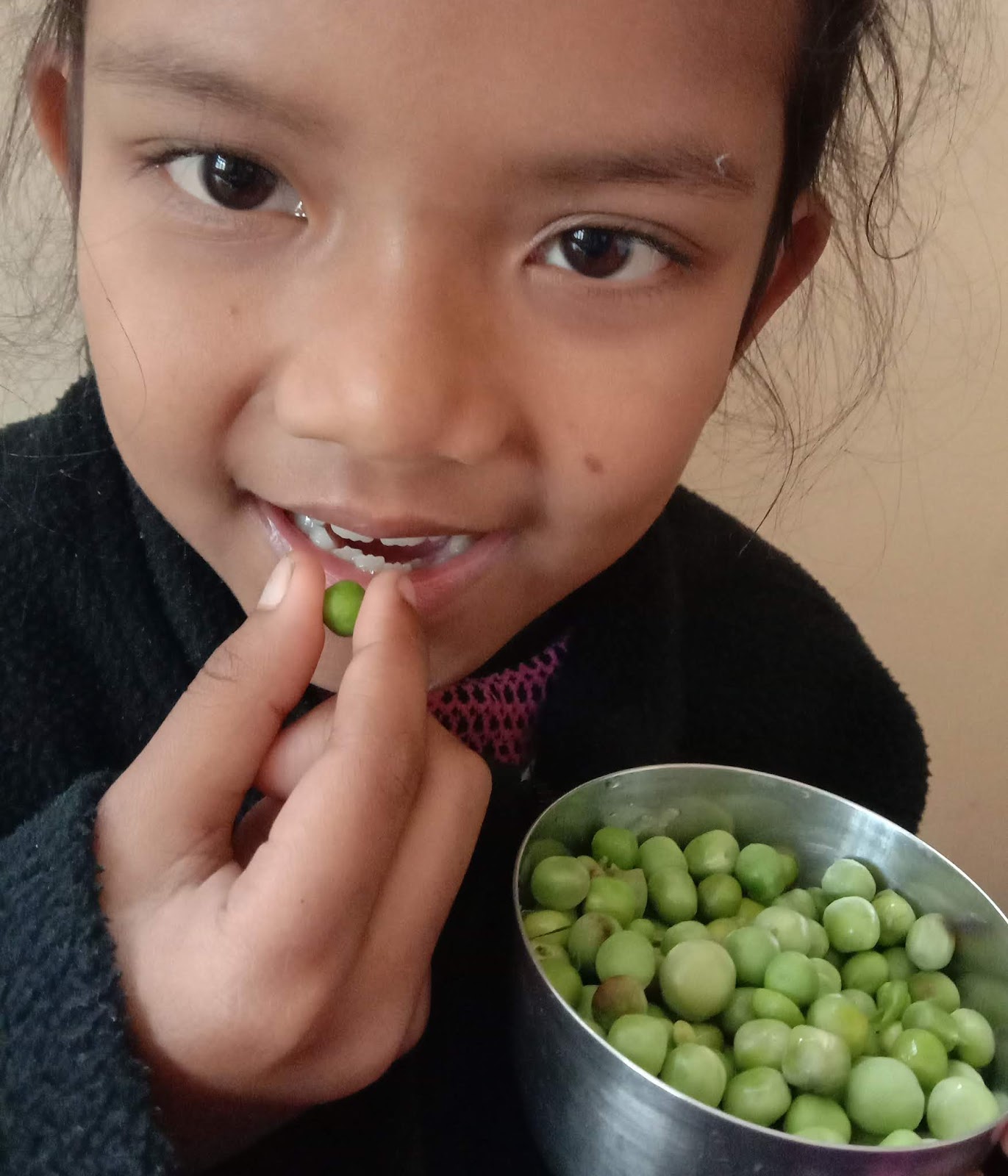
Today, 23 February 2020. We are studying the pea which is a legume and eaten as a vegetable. It is a climber.


ORIGINS: The pea is believed to have originated in the Middle East, Mediterranean, and the Egyptian Nile area.


NUTRITION: The pea gives us a lot of Vitamin C along with fibre, Vitamin A and potassium among other good nutrition.


METHODOLOGY: We were paired with a friend and received a pod to etudie (as the French put it). Shila, Krit, Aarambha, Snigdha, Vidheha, Bishes, Shuvan, Mridvika, Aadhijay and Siddhant were involved in the study. After studying the pod, we opened it and observed what was inside. We measured and described the content. Then we proceeded to document the smell and taste of the plant. 


POD: First we had to study to outside of the pod. 
- The color of the pod was green, getting darker at the back. 
- The shape was long and narrow. 
- The length was 12.1 cm and the width 2 cm.


PEAS: After studying the pod, we opened it. Inside we saw spherical seeds that were light green. There were ten peas in my pod. Two on the top and bottom was very small with the other eight being big. The smallest peas were 3 mm and 4 mm in diameter. The largest pea was almost 9 mm in diameter. On one side the peas were a little white, especially with little connecting points where they were attached to the pod. The peas were not perfectly spherical. We saw that the seed broke up into two equal parts connected together by a skin. Therefore, the pea is a dicotyledonous seed. 

SMELL: The peas smelled of green leaves but the smell was light.


TASTE: The small peas were a little sweet and bitter. The largest peas were sweet. Some did not have much taste.


Friday, January 31, 2020

The Mud Wasp Or the black widow killer


Or the black widow killer
by Shila Shrestha


On the afternoon of 24th January, 2020, we found a cockroach. We collect insects when we find them so we can continue our entomological studies. As we were putting cockroach inside the plastic container where we save our samples, I saw a beautiful blue green wasp inside! Someone had found it and put it in for us to learn about!


We have studied the cockroach several times and we were going to study a different aspect of it this time but we have never ever done the mud wasp. So we were excited and asked if we could do the mud wasp study the next day. I was asked to look up the insect and do some online research beforehand.

January 25. In the morning, our teachers made ready for the wasp experiment. Our tool box was taken out along with the microscope. A teacher put the wasp on the circular glass plate. We looked the wasp which was very blue, green, black and sparkling in color. What an amazingly beautiful insect or arthropod.


While we were doing artwork Pallav sir researched more about the wasp. We wanted to know the name, where it lives, its different body parts and so much more. Sir gave us a well-researched print out to study, discuss, and make notes on.

We wrote about the details of the wasp. The wasp we had was a mud wasp, and it is also a black widow killer.


When we took wasp outside in the sun, it looked very shiny due to ray of sunlight. It sparkled like jewel. So we took photos of the mud wasp, it was so very beautiful. I had researched the taxonomy of the wasp.

We talked a lot about the mud wasp and what it does, how it lives, how it helps and why it could sting. It lives on its own, mostly! We looked at the wasp under the microscope. We looked at the body as well as the head. Little Zoya who is 14 months old also looked at the wasp through the microscope!


Classification
Scientific name: Chalybion californicum
Kingdom: Animalia (Animal)
Phylum : Arthropoda (Arthropods)
Subphylum: Hexapoda (Hexapods or with six legs)
Class: Insecta (Insect)
Order: Hymenoptera (Ants, bees, wasps and sawflies)

These are things that we wrote in our copy. It was a long class but very interesting. Then we continued on to our unfinished artwork. We drew the wasp very nicely, taking a lot of time. We were learning shading, cross hatch, circular hatch, soft blend in art class and we got to use these technique in our science class. We wanted to color the artwork! After finishing our artwork we finished to make notes.

Our experiment class went very smoothly. It was a lot of fun.

Wednesday, January 22, 2020

Koi carp, a scientific study


Koi carp, a scientific study
Cyprinus Carpio Linne
with dissections of Koi and common carps


Science in winter is just perfect, especially when the clouds are in the sky and threatens rain and makes things cold. Today we are going to study the Koi carp and the common carp. “I love science,” Adhijaya said when he learned that we were going to do some experiments.


The Koi carp was beautiful and orange. Pallav sir had brought it from Lagankhel. He had also brought a nice sized common carp. While we were going to study the Koi carp mostly, we were also going to dissect the common carp.


To begin with, we did a physiological study of the carps. There were two groups. Srijana ma’am took the smaller young: Kashi, Nirousha, Khayanna and Shourit. After the children had looked at the Koi carp, she had them sitting down and making artwork of studying the common carp as it was slightly bigger. Its scales were big and it was beautiful!


Sabina ma’am took over the older young: Shila, Vidheha, Anusha, Shuvam, Adhijay, Bishes. They too made artwork but Shila was busy with photography and supporting the learning. Anita didi was busy turning the research material into a readable hand out.


Once the study and the artwork was over, little 14 month old Zoya also came and we gathered around the table and started the dissection. First Pallav Sir again showed Koi has scales, skin, fins, operculum (gill cover), eyes, nostrils, barbels and lateral lines.


Pectoral, ventral, dorsal, caudal and anal fins help the fish move, he said. Pectoral and ventral fins are like hands and legs! A fin has bone-like spine, soft filament and membrane. The fin grows back if it is cut or damaged.


The barbels (which are like moustaches) help with taste as koi carp are bottom feeders that also eat food that floats. It is omnivorous. Koi carp has three rows of teeth in its neck and not in the mouth, funny! They filter plankton from water. Lateral lines are scales along the side from head to tail. They help hear the sounds. Five pairs of Saiko in the gills help the koi carp breathe.


The kois skin secretes mucus on the body which prevents parasites like worms from sticking and disease causing animals and plants. It also helps the fish swims. Koi carp is colourful because of four kinds of pigment cells. They react to light.


The scales form a circle that increase in numbers as the koi grows older. Counting the circles can help us tell the age of the koi carp. The koi does not have a stomach and the esophagus is joined with the intestines. The fatter intestine secretes the digestive fluid. They have one organ that does the work of the liver and the pancreas. The green gallbladder is connected to the liver. It has air bladder has two bubbles. The heart has pericardium, atrium, ventricle, and artery.


Anus is attached to the rectum, ureter and gonads. Gonads make sperm or ova. Koi carp lives in fresh water that is 8 to 30 degrees Centigrade. If the koi looks white, it is probably cold. Under 7 degrees, the koi carp hibernates and dies below 2 to 3 degrees.


 Koi carp eats insects, shellfish and plants. It eats everything twice, first swallowing it, then disgorges what is has swallowed when it is free and chews the food with the teeth it its neck. It lays 200,000 to 400,000 eggs that are externally fertilized and hatch average four days later. A koi carp usually lives for 70 years.


Monday, January 13, 2020

Prawns and Shrimps


A Study of Crustaceans
Science experiment


We watched two documentaries on shrimps and prawns today. One was from the National Geographic and how these animals clean the waters and the other was from How It’s Done that explained how they are farmed.

At Spiny Babbler we study the arthropods on a regular basis. Prawns and shrimps are arthropods. We learned that there are over 2,000 different shrimp species. Their size varies from very small to as big as an arm. They are good at swimming.


Like all arthropods, these crustaceans have exoskeleton. Their bodies are divided into head, thorax, and abdomen. Shrimps have three pairs of legs and gills are plate-like.


A sample species is the Indian prawn and scientists call it the Fenneropenaeus indicus. Both prawns and shrimps belong to the order Decapoda. Shrimp belongs to suborder Pleocyemata prawn while prawn belongs to suborder Dendrobranchiata.


Shrimp species can make a snapping sound that is louder than any other marine noise by hitting their large and small pincers together. They do this to communicate or to stun their prey.


Shrimps are omnivorous. They consume microscopic plants and animal matter by filtering the water around them or sifting through the ocean floor. Certain types of shrimp also catch and eat small fish.


Both prawns and shrimps are considered gourmet food around the world. They are low in calories and high in protein. They contain a cancer-fighting mineral called selenium.


Thursday, April 11, 2019

Vegetables, vegetables, vegetables


Vegetables, vegetables, vegetables
2 April 2019, Tuesday
by Anita Bhattarai
Those who have been with us for a long time know that we plant sooooooooo many plants! We have planted many types of flowers, fruit and vegetables. We plant the seeds or saplings, take care of all the plants by watering them and adding fertilizers, weeding them and putting them in sunlight if needed or protecting them from too much water.

Our flowers are in our small garden patch and all our vegetables are at the back kitchen garden patch. The fruit that we plant are taken care of until they are good sized saplings and they are taken to the village to plant. We have done avocado, lemon, mulberry and camphor trees.
 
The flowers are great to look at and to study: ovules, stigma, pollen…. We take care of the vegetables until they are ripe and ready and then we eat them. We eat the leaves as in spinach, vines as in pumpkin, fruit as in eggplant and squash, and roots as in radish.
 
Before I was even here, the spiny babbler kids had planted a lot of avocado seeds and had given 52 avocado trees to be planted in a village in Dhading. The most recent vegetables we planted was spinach. We took care of them, saw them germinate, we weeded and gave them water, we picked away the plants that had grown too thick, we transplanted the saplings to make sure distances were good and we put fertilizer. 
When they fully grew, we ate what we had taken care of for months and when we ate our lunch and dinner using what we had planted and taken care of, we had a very satisfying feeling. Right now our kitchen garden patch is pretty empty as the spinach that we were eating is finished. There is still lettuce that we eat and also Zoya who is six months old eats. 
There is celery, shallot, aloe, onion but we wanted more so we decided to plant more vegetables. We went to Lagankhel and bought lots of different vegetable saplings. We bought chilies, eggplants and tomatoes. Sabita didi helped us dig up the land and made holes at appropriate distance. We planted the saplings in the holes and covered the roots gently with soil.
Everybody helped with the planting and everyone got to plant several plants. Then we watered the plants. We will take great care of the saplings till they are fully grown by giving them plenty of water, making sure they are healthy. We are finding ladybugs and we are putting them in the flowers that have aphids on them.
 
I am happy really we are getting to eat what we grew by ourselves. Pallav sir says that our work contributes thousands of rupees to our school. He said that we grew more than Rs. 4000 worth of spinach alone in the last three months. Yay!